Commit vs Brick
Commit and Brick both block apps until you tap your phone on something. Here’s how price, phones, emergency unlocks and features compare.
The short answer
Commit and Brick work in almost the same way: choose the apps to block, start a session, and normally unblock them by tapping your phone on something you’ve left in another room. Both also offer schedules and emergency unlocks.
- Choose Commit if you’re in the UK, Australia or the US, use an iPhone, and want a wake-up alarm you finish by scanning the card, or phone-free time with friends who don’t own a card. In the UK it’s also the lower price.
- Choose Brick if you use Android, live somewhere other than the UK, Australia or the US, or share a home with both iPhones and Android phones.
How they work
Both are physical app blockers. Your phone reads them with NFC, the same short-range radio Apple Pay uses, so neither needs a battery, charging or Wi‑Fi.
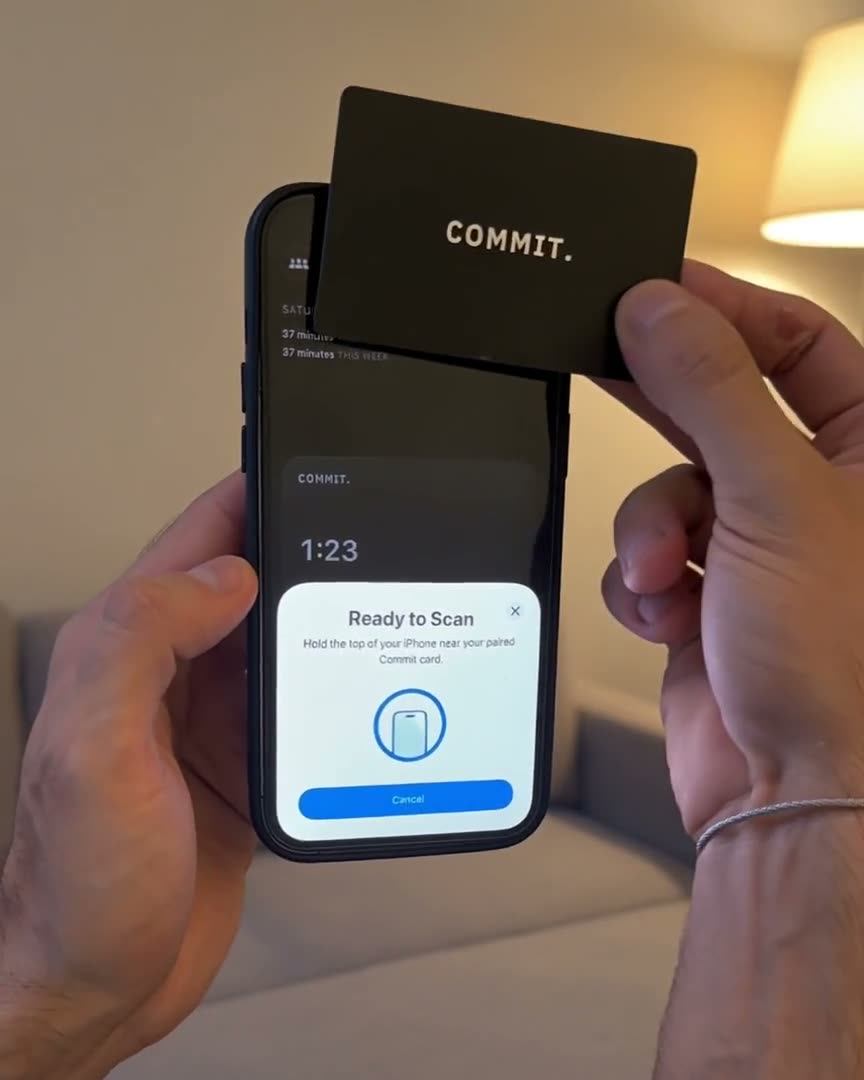
You pick the apps and websites to block in the app. You can start a session without the object in your hand: in Commit you touch and hold the card on screen, and Brick’s Remote Activation does the same with a press and hold. Ending the session is the part that matters. Your apps stay blocked until you walk to the card or the Brick and tap your phone on it.
That walk is the whole idea. When unblocking takes ten seconds of standing up rather than one tap, most of the urges to “just check” pass before you’ve reached the kitchen.
Side by side
| Commit | Brick | |
|---|---|---|
| Price in the UK | £29.99, free delivery. Two cards £49.99 | Roughly £35–£60 for one before shipping; multi-buy offers vary |
| Subscription | None. The app is free with every feature | None. Lifetime app access included |
| Phones | iPhone, iOS 17 or later. Android coming soon | iPhone and Android 12 or later |
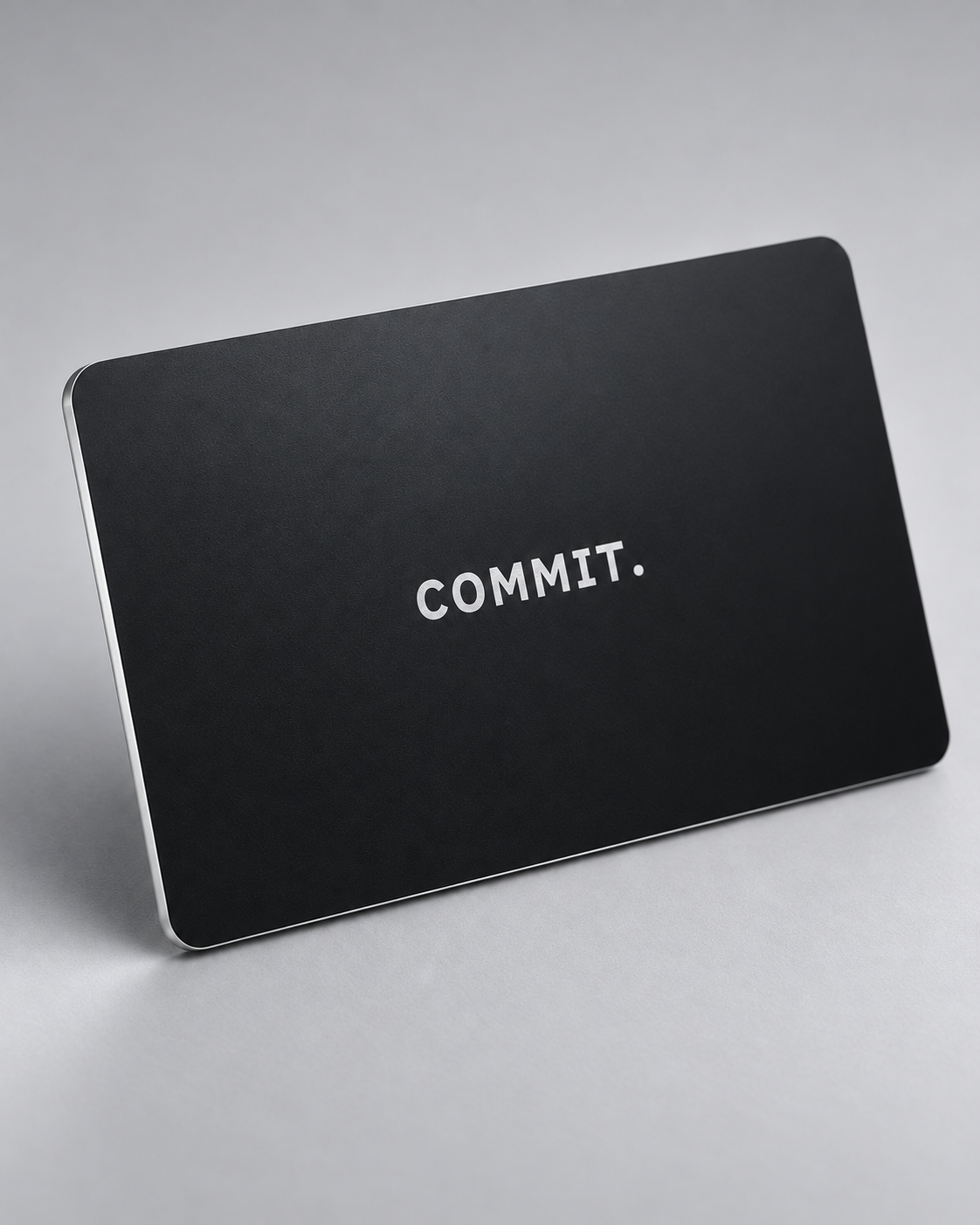
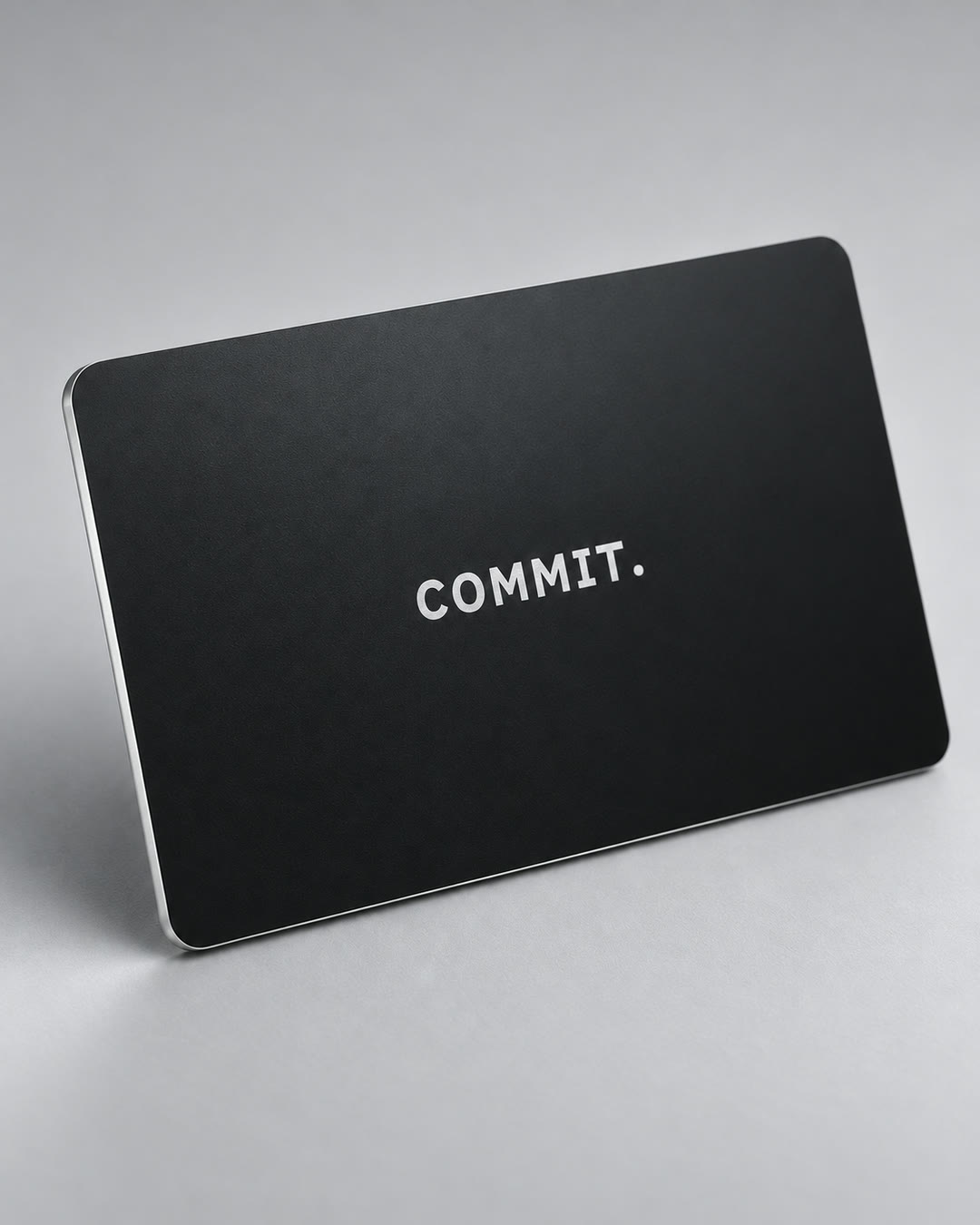
| What you get | A matte-black stainless steel card, the size of a bank card | A magnetic puck with an anti-slip silicone base |
| Battery | None | None |
| Emergency unlocks | Four included, one added back every 60 days up to four. Three more: UK £1.99 / AU A$2.99 / US US$1.99 (App Store country) | Five Emergency Unbricks |
| Strict mode | Can stop deleting apps, installing apps, changing the clock and in-app purchases; can turn off Siri and block adult websites | Stops deleting the app or changing settings to unbrick |
| Scheduling | Repeating routines, plus one-off sessions planned on your calendar | Schedules |
| Sleep and waking | Wake: an alarm you finish by scanning the card, with optional app blocking overnight (iOS 26 or later) | Brick Night, a separate Bluetooth device, roughly £90–£140 in the UK |
| With friends | Group Commits for up to 20 people. Guests need no card or account | One Brick can be shared by multiple phones |
| Delivery | UK, Australia and the US. Dispatched by the next business day | Worldwide, with local fulfilment in the US, UK, Australia, Netherlands and Canada |
| Returns | 30 days | 30-day money-back guarantee |
Where Brick is the better choice
Android. Brick works on Android 12 or later, and Commit doesn’t yet. If you use Android, or your household has a mix of phones and wants one device for everyone, Brick is the straightforward answer.
Outside the UK, Australia and the US. We deliver to those three countries for now. Brick ships worldwide.
A fixed spot. Brick has a magnet and an anti-slip base, and sells a mount, so it can live on the fridge or the side of a desk. A card is easier to lose behind something.
Track record. Brick has thousands of App Store ratings. Commit launched in October 2026.
Where Commit is the better choice
Price. In the UK, one Commit Card delivered costs £29.99, against roughly £35–£60 for one Brick before shipping and offers.
Waking up. Commit’s Wake alarm keeps ringing until you get up and scan your card, and Night Protection can block your chosen apps from bedtime until the alarm. Brick sells a separate Bluetooth device, Brick Night, for sleep. Wake needs iOS 26 or later.
Doing it together. With a Group Commit, up to 20 people block their own choice of apps and start together. Friends only need the free app: they finish by scanning your card, or when the agreed time is up.
Planning ahead. As well as repeating routines, you can place a Commit straight onto your calendar, or attach one to an event so it moves when the event does.
Emergency releases come back. You start with four, and one is added back every 60 days, up to four. You can also buy three more in the app for £1.99 in the UK, A$2.99 in Australia or US$1.99 in the US (App Store country). If you start a session by mistake, you can cancel it free within its first minute.
Neither one is unbreakable, and that’s fine
On iPhone, every app blocker, including both of these, uses Apple’s Screen Time framework. On a self-managed iPhone, iOS lets you remove an app’s Screen Time access in Settings, and both apps give you emergency unlocks for when you genuinely need your phone. A blocker that could trap you away from your maps or your bank in an emergency wouldn’t be safe.
What both get right is that the easy option becomes the good one. Most scrolling is a reflex rather than a decision. If stopping the reflex means getting up and walking to another room, you’ll do it far less.
Our recommendation
If you’re on an iPhone in the UK, we think Commit is the better value, and the only one of the two with an alarm and group sessions built in. If you’re on Android, live somewhere other than the UK, Australia or the US, or need one device for a mixed household, get a Brick. Either will do more for you than another Screen Time limit. If you’re weighing up others too, see physical app blockers compared.
Sources
- Brick product page (UK prices, features, compatibility and Emergency Unbricks)
- Brick FAQ (shipping, multiple phones) and Brick Night (UK price, Bluetooth)
- Brick App Store listing (track record)
- The Commit Card and Commit delivery and returns
Questions
- Is Commit cheaper than Brick?
- In the UK, yes. One Commit Card is £29.99 with free UK delivery. Brick’s UK website puts one Brick in roughly the £35–£60 range before shipping and offers. Neither charges a subscription.
- Does Commit work on Android?
- Not yet. Commit works on iPhones running iOS 17 or later, and Android is coming soon. Brick works on iPhone and on Android 12 or later, so it’s the better choice if you use Android today.
- Can my household share one Commit Card or one Brick?
- Yes, with both. Everyone at home can pair the same Commit Card to their own iPhone, up to a limit of phones. Brick says one Brick works with as many phones as you like, on iPhone or Android.
- What happens if I lose the card or the Brick?
- Both give you emergency unlocks. Commit includes four emergency releases, adds one back every 60 days up to four, and sells extra packs of three in the app. Brick includes five Emergency Unbricks. With Commit you can then pair a replacement card.
- Can you get round either of them?
- If you’re determined, yes. On iPhone, both use Apple’s Screen Time framework, and on a self-managed iPhone, iOS lets you remove an app’s Screen Time access in Settings. Both have a strict mode that stops you deleting the app mid-session. The aim is friction, not a lock you can never open.